When previous generations were growing up, screens weren't competing for their attention in the way they do today. Like so many of those generations, we only came indoors to eat and sleep. Climbing trees, running through fields on uneven ground, scrambling over anything climbable, playing for hours on end. We didn't know it at the time, but we were quietly building something essential: a broad, varied movement foundation that most conventional sport programs were never designed to replicate.
Today's young athletes live in a very different world. The research supports what many coaches and parents have sensed for years. Three converging forces are reshaping how young people develop physically, and not for the better.
The first is early sport specialisation. This is the most evidence-backed concern of the three. The American Academy of Pediatrics (2024), the International Olympic Committee (2015, updated 2024), and multiple systematic reviews consistently find that early single-sport specialisation, particularly year-round, at high volume, with inadequate rest, is associated with significantly higher rates of overuse injury, burnout, and poorer long-term development. What matters is understanding that specialisation itself may not be the only culprit. The real risk often lies in what comes with it: high cumulative load, repetitive tissue stress, insufficient movement variety, and limited recovery. It is a complex problem.
The second force is the erosion of outdoor, unstructured play. Systematic reviews consistently report meaningful associations between active outdoor play and better motor competence, physical activity habits, and broader physical health. What children gain from hours of free movement, uneven surfaces, improvised challenges, varied loads, is not easily replicated by most sport training sessions.
The third is screen time. More recent evidence, including umbrella reviews (Norwegian Institute of Public Health, 2024) and CDC analysis (2025), links high daily screen time among adolescents to lower physical activity levels, reduced strength training participation, poorer sleep, and concerning associations with musculoskeletal pain and motor development. The mechanism is not complicated: screen time crowds out movement, and movement builds the physical literacy that sport demands.
The full causal chain, from increased screen time and reduced outdoor play to a measurable rise in sports injuries at every level, has not yet been proven in one clean study. Researchers rightly caution that comparing injury rates across eras is difficult; better surveillance methods alone now identify far more problems than older reporting systems. But the picture that emerges from the evidence is coherent and increasingly hard to ignore: modern youth are arriving at organised sport with a narrower physical foundation than previous generations, and the consequences are showing.
We are consistently struck by how many young athletes, who are very competent at their respective sports, struggle to perform proper push-ups, and more so with pull-ups. The problem is a deficit in development across all three components of the kinetic chain (muscular, skeletal, and neuromuscular), the kind that used to happen organically through play. Identifying and closing those gaps is exactly what Beyond Motion is built to do, both to reduce injury risk and to unlock the full performance potential.
The research framing for this is “physical literacy”: the combination of movement competence, physical confidence, and the motivation and knowledge to be active for life. It is built through variety, volume, and time. What we see in many young athletes isn’t a lack of application, but rather a deficit of the foundational hours that their ability needs to develop.
The model that emerges from the literature is straightforward: more screen time and less free play leads to less varied movement and lower physical activity overall, which produces lower movement competence and reduced physical literacy. When those athletes then enter organised sport , often with early specialisation and high training loads, repetitive stress exceeds what their tissue and motor-control capacity can handle. The result is more overuse problems and a higher risk of non-contact injury. Every part of that chain has research support, even if the full picture is still being mapped.
Beyond Motion exists to fill that gap. Our focus is threefold: building the foundational strength, coordination, and physical literacy that protects young athletes from injury; unlocking the performance gains that a solid foundation makes possible; and developing the confidence that comes from genuinely knowing what your body can do. These are not separate goals. They are the same goal approached from different directions.
Every athlete starts with a comprehensive baseline assessment: sprint, jump variations, agility drills, and reaction time testing. Alongside this, a profile questionnaire helps us understand each athlete's interests and motivations. From there, we build a program tailored to their specific needs, in an environment that's genuinely challenging and genuinely fun.
For athletes who already have a strong physical foundation and want to go further in a particular sport, we develop targeted programs built around their personal and team goals.
We reassess periodically to make sure we are truly serving each athlete, refining programs continuously, because what gets you started isn't always what gets you to the next level.
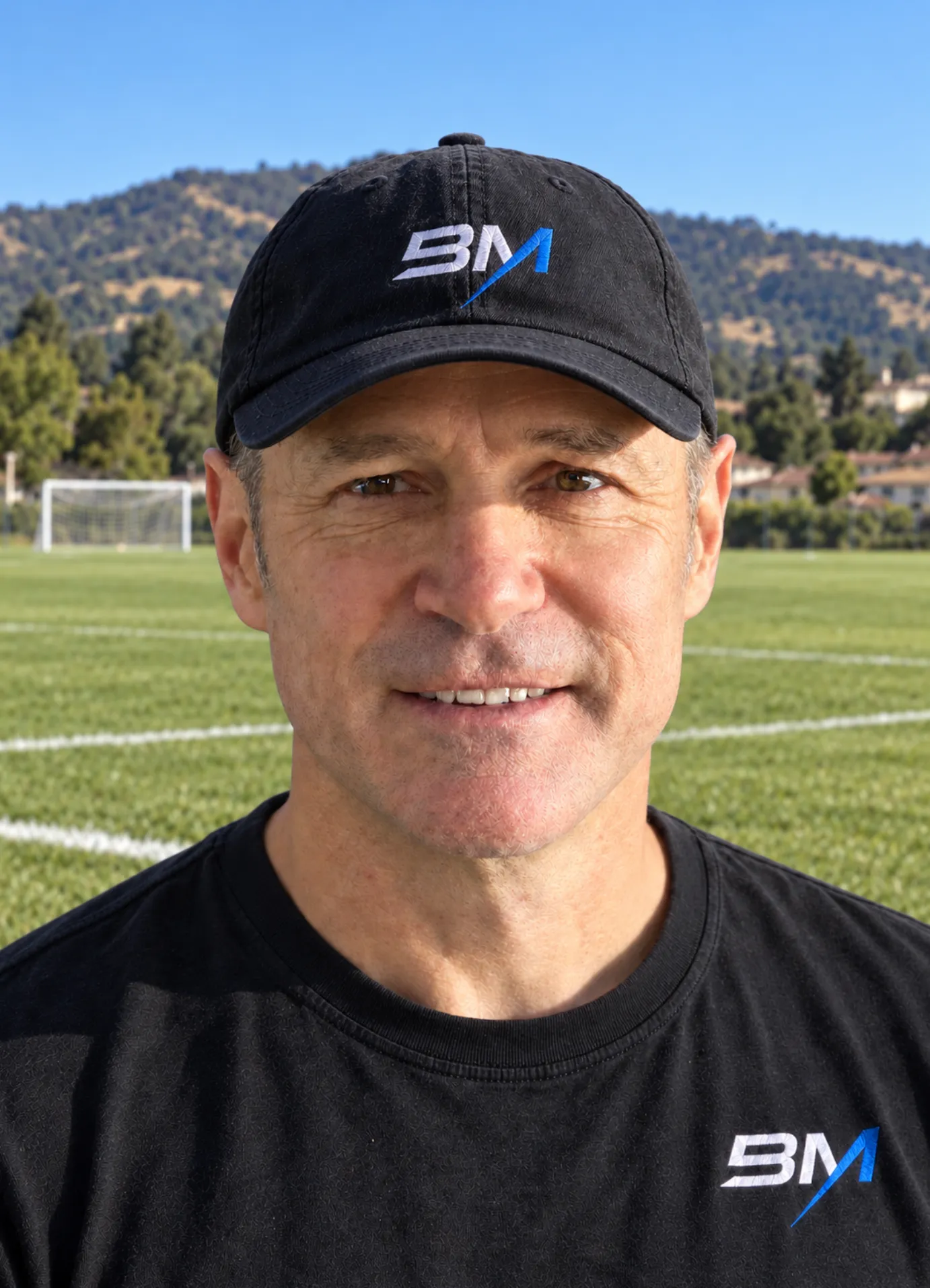
Beyond Motion was founded by Evan McKay, who grew up in Cape Town, South Africa, a culture where sport isn’t just an after-school activity, it is simply a way of life. Before the age of ten he was playing rugby, cricket, tennis, athletics (track) and swimming. Surfing arrived at eleven; water polo, rugby and sailing followed through high school and university. The move to the States brought snowboarding, kiteboarding, and football (soccer) to the fore. Whether observing, analyzing, coaching or participating, sport remains what he is most passionate about.
After completing a degree in Psychology at the University of Cape Town, Evan moved to the US in his mid-twenties, eventually finding his way into coaching, first in kiteboarding and snowboarding, then across four years of competitive youth football (soccer). It was there that the insight behind Beyond Motion crystallised: observing many young athletes being held back not by lack of application, but by gaps in their physical and mental foundation.
With a psychology background and 15 years working in schools, understanding what drives a young athlete, intrinsically and extrinsically, shapes everything from how programs are designed to how progress is measured. At Beyond Motion, speed, agility and mindset are trained with equal intention, because lasting athletic development is as much about who an athlete becomes as what they can do.